



This is not medical advice. General information about calorie tracking apps, not a treatment plan. If you are under 18, pregnant or breastfeeding, have ever had an eating disorder or a difficult relationship with food, or are managing a medical condition, talk to a doctor or a registered dietitian before you start counting calories. The full list is here.
Switch to MyPlate if you photograph most of your meals and Cal AI's numbers keep landing wrong without telling you why. MyPlate shows the guesses behind each scan and lets you change them.
Stay with Cal AI if most of what you eat has a barcode or a database entry, or you want your log synced through an account and on your watch. MyPlate has no barcode scanner, no database and no account to sync.
Download MyPlate on the App Store → · Get it on Google Play →
Why people leave Cal AI
I read the reviews rather than guess. On 18 November 2026 I pulled the 500 most recent United States App Store reviews of Cal AI, written between 3 July and 15 November 2026. Of those, 242 were at two stars or fewer.1 A script grouped them by keyword, so treat the counts as rough groupings and the reviews themselves as the evidence.
The largest group is about money: 88 of the 242 mention the price, the trial or the subscription. Cal AI's listing says plainly that food scanning results require a subscription.2 I am not building this page on that complaint, because MyPlate does not fix it. MyPlate is a subscription app too, with its plans shown in the app before you buy.3 If price is why you are leaving, I am not your answer.
The second group is the one this page is for. 47 of the 242 complain about the photo estimates: wrong foods, wrong portions, calories that feel too low.1 Many of them are less about the first number than about what happens after it: by my own count, about 19 of those reviews describe having to correct, re-enter or double-check the result. One put it in a sentence: "You take a picture and it gets the ingredients and all the macros are wrong so you have to re-add them." Another named the thing a camera cannot see: "Remember it doesn't know what you cook with so all butter and oil is not accounted for."1
I want to be careful here. I am not going to tell you MyPlate's estimates are more accurate than Cal AI's. I have no measurement that compares the two, and MyPlate is the same kind of tool: an AI model reading a photo. Its estimates are wrong sometimes as well. What I can describe is what MyPlate does when the estimate is wrong, and that is the difference this page is about.
A smaller group, about half a dozen reviews, describes account trouble: a confirmation email that never arrived, a login screen that spins, being signed out and unable to get back in.1 Cal AI's own help page tells you to sign back in with your Google account or Apple ID, and says your data is stored in the cloud.4 MyPlate has no account at all, which removes that problem and creates a different one, covered below.
Cal AI vs MyPlate, side by side
Everything in this table comes from each app's own App Store listing, Google Play listing or website, checked on 18 November 2026. Prices are United States prices, and features change, so check both listings before you decide.
| Cal AI | MyPlate | |
|---|---|---|
| How you log a meal | Photo, barcode, a description, or a search of its food database4 | Photo, gallery image, or a description typed or spoken3 |
| What a scan gives you | Calories, protein, carbs and fat4 | The same, for each ingredient separately3 |
| Shows what the estimate assumed | Not described on its listing or website24 | Yes: how sure it is, a likely calorie range, and each guess, any of which you can swap3 |
| Food database | Over 1 million foods4 | None |
| Barcode scanner | Yes4 | No |
| Account | Yes, with the log stored in the cloud4 | None. No email, no password3 |
| Price | Free download; scan results need a subscription; in-app purchases listed from $0.99 to $29.992 | Free download; subscription plans and prices shown in the app3 |
| Platforms | iPhone, Apple Watch, Android25 | iPhone, iPad, Android36 |
| Exercise, water, Apple Health | Yes4 | No |
| App Store rating | 4.8 from 376,076 ratings2 | 4.1 from 20 ratings3 |
I put the ratings in on purpose. Cal AI has been rated by more than a third of a million people on the App Store, and about 272,000 more on Google Play.5 MyPlate has been rated by twenty. An average from twenty people tells you very little, and you should weigh it that way. If you are choosing among more than these two, I compared eight kcal tracker apps on price, free tier and where their numbers come from.
The third row needs a fair reading. It says what Cal AI's own pages describe, not what the app can or cannot do once it is open. Several reviewers describe editing their entries, so do not read the row as saying a Cal AI scan cannot be corrected. What I could not find on Cal AI's listing or website is any mention of the estimate telling you what it assumed.24
What logging a meal looks like in each
Cal AI's listing describes three steps: answer lifestyle questions to build your plan, snap a photo of your meal, get your nutritional breakdown.2 Its website adds that the phone's depth sensor calculates the food's volume before the AI breaks the meal down into calories, protein, carbs and fat.4 When a scan comes back wrong, Cal AI's help page suggests better lighting, a photo where the food fills the frame and is in focus, updating the app, and sending support a screenshot if it is still way off.4
MyPlate starts the same way and then keeps going. You take the photo, pick one from your gallery, or describe the meal in a sentence. The dish comes back with every ingredient listed separately, each with its own calories and macros. The App Store listing's own example is a steak dinner: "Sirloin steak, 249. Brussels sprouts, 65. Olive oil, 44."3 Under the totals, the scan says how sure it is, as "Clear estimate", "Good estimate" or "Rough estimate", with a likely calorie range.
Below that is a row headed "What I went with". Each item there is one guess the AI made: what a food is, how much of it there was, how it was cooked, and anything the camera could not see, like the oil in the pan or a sauce under the rice. Each ingredient also carries a marker: "Best guess", "Added, often hidden" or "Confirmed". The oil that reviewer said goes missing is exactly the kind of thing that shows up as "Added, often hidden", where you can see it and decide whether it belongs.
Tap a guess and the alternatives appear, each with the change in calories shown next to it before you choose. Say the scan guessed the chicken was fried and it was grilled: you see what the switch takes off the total, pick it, and the dish updates. Undo puts it back. If the scan was rough, it also asks you one quick question. Anything it got wrong that is not covered by a guess, you can edit by hand, ingredient by ingredient.3
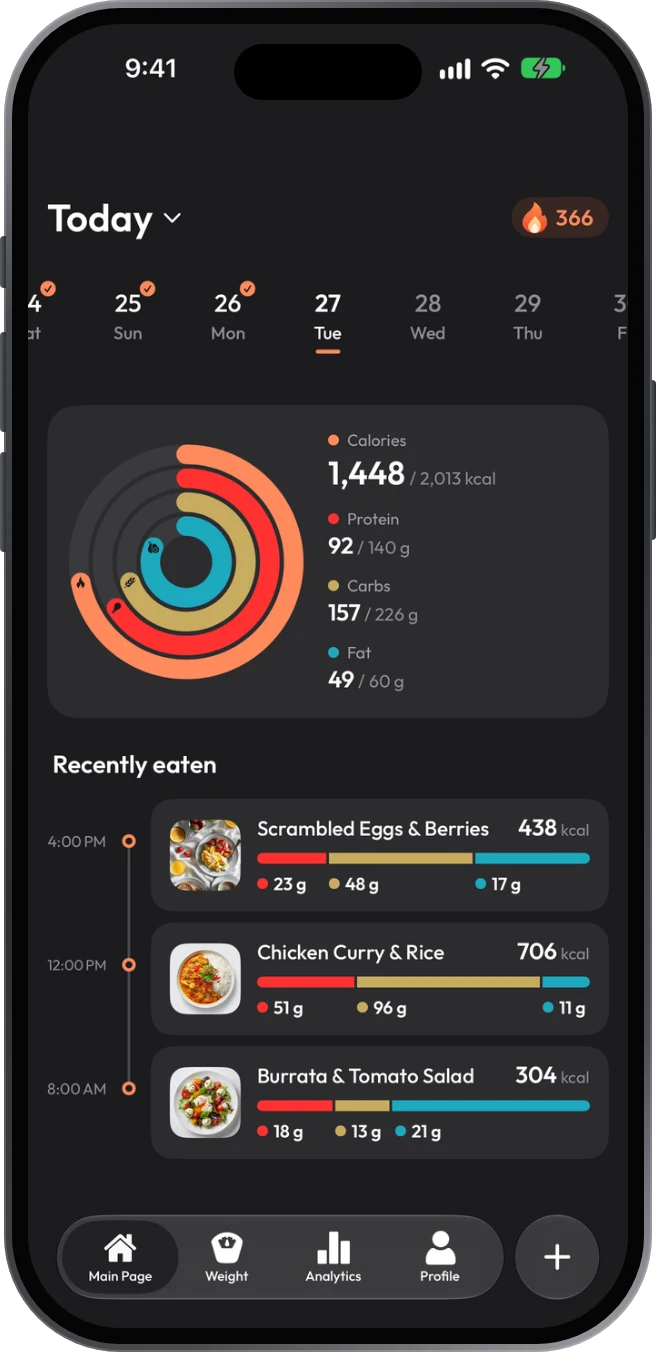
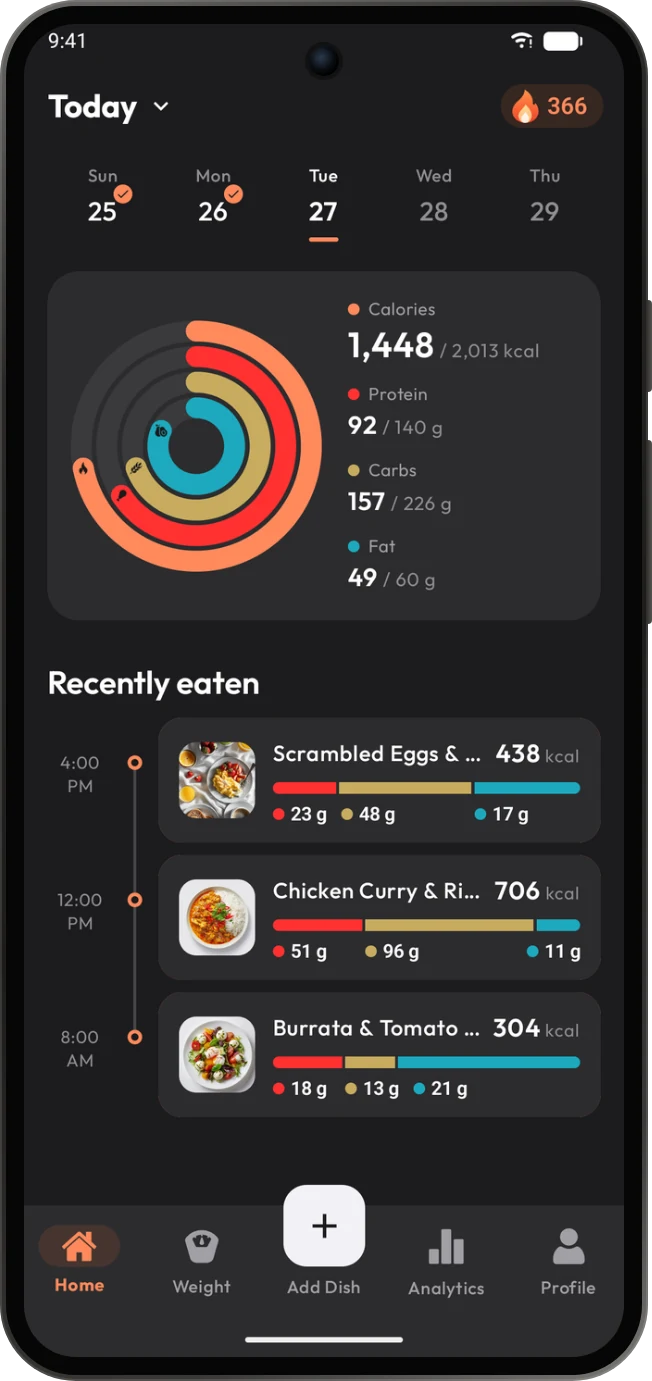
None of this turns a photo into a measurement. If you never check the guesses, a wrong one stays wrong, and a photo still cannot weigh your portion. I have written up how far off photo and database tracking both run, and the short version is that every method misses, so a consistent log matters more than a perfect one. The point of the guesses is narrower: when the number looks off, you can see which assumption caused it and fix that one, instead of retaking the photo or re-entering the meal.
Where Cal AI is still the better app
Any one of these four is a good reason to stay.
It has a database and a barcode scanner. Cal AI's website describes more than a million foods, searchable by name or brand, and barcode scanning for packaged food.4 If most of what you eat comes out of a packet, reading the label beats estimating it from a photo, and MyPlate has neither feature.
Your log survives your phone. Cal AI's help page says your data is stored in the cloud, and that reinstalling the app will not delete it as long as you sign back in.4 MyPlate keeps everything on the device. Deleting the app deletes your log for good, and there is no way to move it to a new phone or between iPhone and Android.3 That is the price of having no account, and you should decide which failure you would rather live with.
It runs on more of your devices and does more around the food. Cal AI is listed for iPhone, Apple Watch and Android,25 and its website describes water and exercise logging and an Apple Health connection.4 MyPlate is on iPhone, iPad and Android, with no watch app, no exercise logging and no Apple Health.36
It is far more widely used. More than 376,000 App Store ratings against MyPlate's twenty means many more people have found its rough edges before you, and many more have stayed anyway.23 If you like the app you have and only want to complain about one scan in ten, keep it.
Who should switch to this Cal AI alternative
One reader, as narrowly as I can describe them. You use Cal AI mostly through the camera, for home cooking and restaurant plates rather than packets. You are fine paying for a calorie counter app. And what wears you down is not the price but the moment after the scan: a number that looks wrong, with nothing to tell you whether it missed the oil, misjudged the portion or mistook the food, so you end up redoing the entry.
For that reader, MyPlate puts its assumptions on the screen. You see what it went with, you change the one that is wrong, and you see the calories move before you commit. It is a good app to track macros in this one situation, a photo of a plate someone cooked, and I would not claim more than that for it.
If that is not you, stay where you are. That goes double if you scan barcodes or want your history on your next phone. And if the subscription is the problem, MyPlate has one too.
Common questions
What is the best Cal AI alternative?
It depends on what made you want to leave. If Cal AI's photo estimates keep coming back wrong and you want to see why, MyPlate lists what each scan assumed and lets you swap any guess, with the calorie change shown first.3 If you rely on barcodes, a food database or an Apple Watch, an alternative without those, MyPlate included, is a step backwards.
Is Cal AI a good app to track macros?
It can be, especially for packaged food. Cal AI logs calories, protein, carbs and fat from a photo, a barcode, a description or a database of over a million foods, according to its own website.4 The complaint in its recent low reviews is about photo estimates: 47 of 242 reviews at two stars or fewer, from the 500 most recent on the US App Store, mention them.1 If most of your meals are photos, check how easy it is to correct one before you commit.
Is MyPlate the most accurate calorie tracker?
Nobody has shown that, and I will not claim it. MyPlate's estimate comes from an AI model reading a photo or a description, and it can be wrong. What it adds is that it tells you what the estimate assumed, how sure it is and the likely calorie range, so you can correct the part that is wrong.3 For how far off every kind of tracker runs, see how accurate calorie tracking apps are.
Does Cal AI need an account?
Yes. Cal AI's help page tells you to sign back in with your Google account or Apple ID after reinstalling, and says your data is stored in the cloud.4 MyPlate has no account, no email and no password, and keeps your log only on your phone.3 The trade is that deleting MyPlate deletes your log, with no way to get it back.
Can I move my Cal AI history to MyPlate?
No. MyPlate has no import, so your past entries stay in Cal AI and your new log starts empty. Your plan starts the same day, from a few questions about your height, weight, activity and goal.3 If the history matters to you, keep the Cal AI account until you no longer need it, and remember that deleting the Cal AI app does not cancel its subscription.4
The bottom line
The largest group of unhappy Cal AI reviewers this autumn is unhappy about money, and MyPlate cannot help them. The ones this page is for have a narrower complaint. The scan comes back with a number that looks wrong, and the app does not say what it was assuming. MyPlate's answer is to show you: the guesses, how sure it is, and what each change would do to the total.
Everything else is a trade you should make knowingly. MyPlate has no barcode scanner, no database, no account to sync, no watch app, and a log that lives in one place and goes with the app.3 It is still an estimate, but one you can check line by line.
Whichever calorie counter app you use, the target matters more than the tracker. MyPlate never shows a daily target below 1,200 calories for women or 1,500 for men, the top of the low-calorie ranges in the NIH clinical guidelines on obesity.7 And if checking every guess starts to feel like a test you are failing, that is a reason to step back from tracking and talk to someone, not to look for a stricter app.
Sources
Every figure above traces to one of these. If you find a number that doesn't match the source it claims, tell me and I'll correct it.
- Apple. (2026). Cal AI - Calorie Tracker, Ratings and Reviews. App Store, United States storefront. Sample of the 500 most recent reviews, written 3 July to 15 November 2026, of which 242 were rated two stars or fewer. Retrieved 18 November 2026. Read the reviews →
- Apple. (2026). Cal AI - Calorie Tracker, App Store listing (version 26.46.0; 4.8 from 376,076 ratings; iPhone and Apple Watch; in-app purchases $0.99 to $29.99; "Food scanning analysis results require a subscription"). Retrieved 18 November 2026. View the listing →
- Apple. (2026). MyPlate - Calorie Tracker, App Store listing (version 4.0.1; 4.1 from 20 ratings). Retrieved 18 November 2026. View the listing →
- Cal AI. (2026). Cal AI | Download Today, home page and frequently asked questions. Retrieved 18 November 2026. Visit the site →
- Google. (2026). Cal AI - Food Calorie Tracker, Google Play listing (4.5 from about 272,000 reviews). Retrieved 18 November 2026. See the listing →
- Google. (2026). MyPlate - Calorie Tracker, Google Play listing. Retrieved 18 November 2026. See the listing →
- National Heart, Lung, and Blood Institute, NIH (1998). Clinical Guidelines on the Identification, Evaluation, and Treatment of Overweight and Obesity in Adults. NIH Publication 98-4083. Read the guidelines →
The formulas and limits behind MyPlate's own numbers, with their citations, are on the health sources page.